




How Do I Help a Rescue Dog When I Don’t Know Their History?

Was my rescue dog abused?

How Do I Help a Rescue Dog When I Don’t Know Their History?
The Hand That Was Hard
She Does Not Need Your File
Some dogs arrive with a history.
Others arrive with a blank space.
And people do not like blank spaces.
So we fill them.
“He must have been abused.”
“She was probably beaten.”
“A man must have frightened him.”
Sometimes those stories are true.
Sometimes they are not.
The difficulty is not that we wonder.
The difficulty begins when the story becomes more important than the dog standing in front of us.
Because once we decide what happened, we begin looking for proof.
A hesitation becomes evidence.
A man in a hat becomes part of the story.
A tightened leash becomes part of the story.
And slowly, the dog can begin inheriting the guardian’s theory.
The story we build can become the ceiling we set.
What happened before your dog came to you may never be fully known.
But there are things you can know.
What does your dog move toward today?
What does your dog move away from today?
Under what conditions?
At what distance?
And how long does it take the body to settle afterward?
Those observations are not guesses.
They belong to the dog who is actually living with you now.
❧
A Small Experiment
For seven days, keep one simple page.
Create three columns:
What my dog walked toward today.
What my dog walked away from today.
How long it took my dog to settle afterward.
Nothing else.
No theories.
No adjectives.
No explanations.
Do not write:
“She’s fearful.”
“He was probably abused.”
“She hates men.”
“He’s stubborn.”
Write only what happened.
At the end of seven ordinary days, look at the page again.
You may know more about the dog living beside you than any imagined history could have taught you.
❧
And there is another important truth here.
Dogs forgive us with extraordinary ease.
A harsh voice.
A hard hand.
A moment when our own fear or frustration spills onto them.
Their forgiveness is a gift.
But forgiveness is not the same thing as repair.
Repair begins when we see ourselves clearly enough to change what happens next.
Your dog does not need you to invent the perfect explanation for the past.
Your dog needs you to become a faithful observer of the present.
That is where the work begins.
We did not win the walk. We came home to each other.
Learn the dog who is here now.
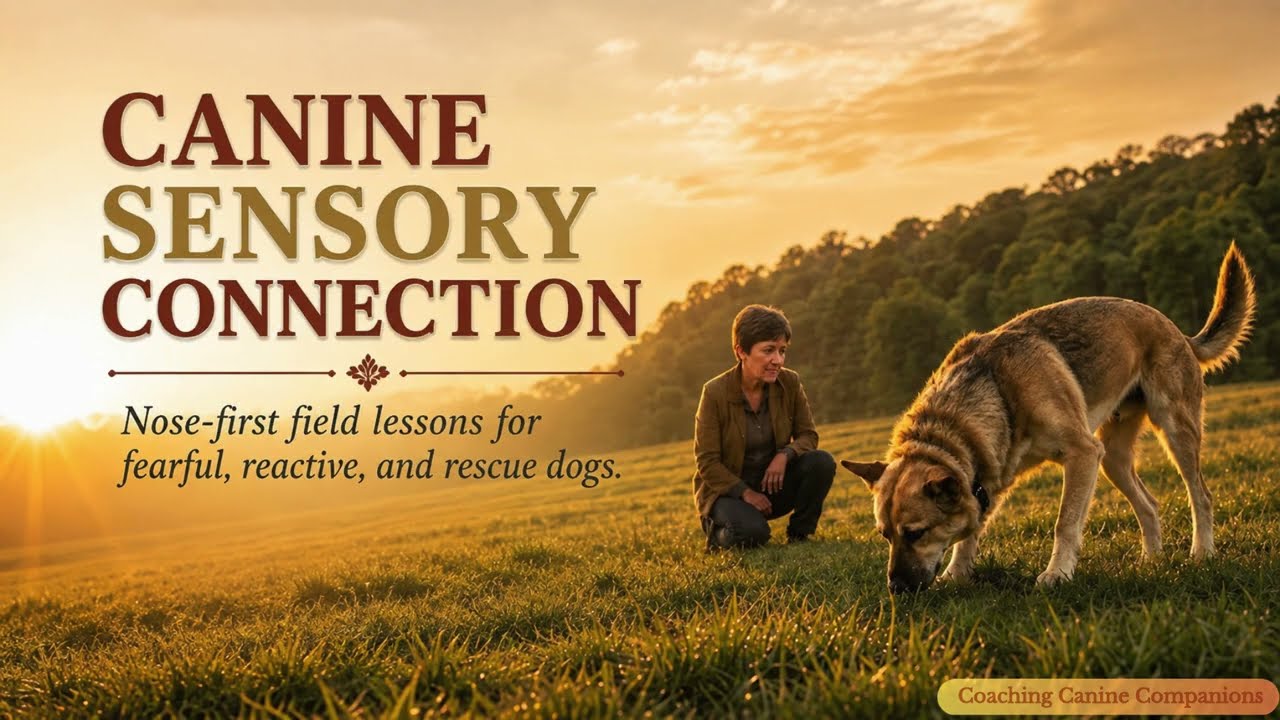
Canine Sensory Connection uses scent, curiosity, observation, agency and recovery to help you discover what your dog moves toward, what they move away from, and what helps them find their way back.
Explore the Canine Sensory Connection Workshop
Force-free throughout. Veterinary care first, always.
Lorrie J. Harris · Coaching Canine Companions · North Kingstown, Rhode Island

Comments