




Why Does My Dog Look Guilty?
Look Again Before You Decide Who Your Dog Is
why does my dog look guilty
The Field Lesson
We are extraordinarily quick to turn what we see in a dog’s body into a story about who that dog is.
Stubborn.
Guilty.
Dominant.
Aggressive.
Difficult.
Sometimes the story begins before the dog has done anything at all.
A broad head. A scarred face. Cropped ears. A powerful body. A particular breed.
Appearance becomes expectation.
Then behavior becomes proof.
But there is an important difference between what a dog is and what a dog is answering.
A dog who freezes may be answering uncertainty.
A dog who pulls away may be answering pressure.
A dog whose body becomes hard may be answering something in the environment that we have not noticed yet.
When we mistake a body’s response for a dog’s character, we stop asking the most useful question:
What is this body telling me right now?
So look again.
Instead of beginning with the label, watch five things:
Breathing. Has it changed?
Weight. Where is the dog’s weight resting, and has it shifted?
Eyes. Are they soft, searching, fixed, or watchful?
Softness. Is the body loose and fluid, or has something become still or tight?
Recovery. After something difficult happens, how long does it take the dog to return to ordinary?
Recovery may tell us more than the size of the reaction itself.
This is one of the foundations of learning to truly see a dog.
We stop reading character from behavior and begin reading information from the body.
❧
A Small Experiment
Take one ordinary moment with your dog today.
First, notice the story that immediately appears in your mind:
“He’s being stubborn.”
“She’s nervous.”
“He’s guilty.”
“She’s difficult.”
Don’t argue with the thought.
Simply set it aside.
Then look only at the body.
Breathing.
Weight.
Eyes.
Softness.
Recovery.
Ask yourself:
If my dog’s body could speak more clearly than my assumptions, what would it be telling me?
❧
You may discover that the dog you thought you knew has been trying to introduce themselves all along.
One person who learns to truly see a dog can become a refuge from a thousand misunderstandings.
Canine Sensory Connection begins with that kind of seeing.
We did not win the walk. We came home to each other.
Learn to see before you decide.
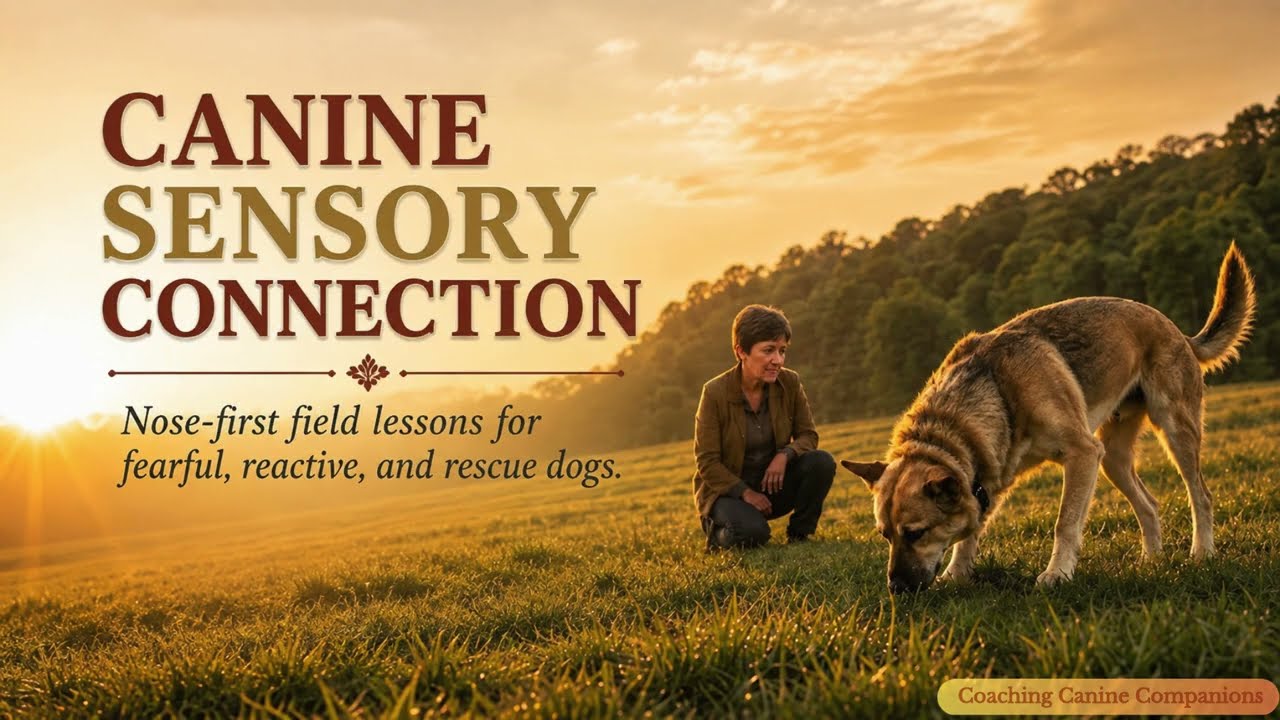
Canine Sensory Connection teaches you to notice the quieter information carried in your dog’s body — and to use scent, curiosity, agency, and recovery to discover what happens when we begin listening there.
Explore the Canine Sensory Connection Workshop
Force-free throughout. Veterinary care first, always.
Lorrie J. Harris · Coaching Canine Companions · North Kingstown, Rhode Island

Comments